In this article
- 1What is a contractor brand, in plain words?
- 2Where should you start with construction branding?
- 3How should you pick and present your company name?
- 4Do your truck, uniforms and yard signs really matter?
- 5How do reviews build your brand?
- 6How should you reply to reviews, good and bad?
- 7What should your website and photos say about you?
- 8How does your first reply shape the brand?
- 9What does a simple weekly brand routine look like?
- 10How does your team become part of the brand?
- 11Where does The Booking Flow fit?
Construction branding is the impression homeowners have of your company before they talk to you: the name on the truck, the stars on Google, how quickly and politely you answer. You shape it with things you already do, and a steady weekly routine matters more than a big budget.
We have not run a crew, so this guide leans on the sources linked below and on what we know about how home service companies handle new leads. Where a point is a judgment call, we say so.
What is a contractor brand, in plain words?
A contractor brand is what people expect from your company before they hire it. It comes from your name, your look, your reviews and the way you reply to people. A logo is one small piece. A homeowner who has never met you still has an opinion, and you can influence it.
Contractor Magazine's May 2021 article "Bold Branding Will Boost Your Business" by Dan Antonelli defines a brand as more than a logo. It includes your company name, colors, typography, tagline, reputation and voice. The article adds that home service contractors face the biggest challenges earning trust, because many people have felt ripped off by a contractor and families are not eager to let strangers into their homes to work.
That is why branding matters in the trades. Someone choosing a roofer or a heating and cooling company is choosing a person who will walk through their house. They look for signs that the company is real, careful and likely to show up. Four parts of the brand are in your hands:
- Name and look: the company name, logo, colors and lettering, matching from the truck to the website to the estimate
- Reputation: your Google rating, how many reviews you have, how recent they are and how you answer them
- Voice: how your emails, web pages and replies sound, friendly and plain or stiff and vague
- Behavior: whether you arrive when you said, keep the site clean and explain the work, because that is what people repeat to neighbors
Where should you start with construction branding?
Start by writing down who you want to hire you and what you promise them. Pick the one to three kinds of customers you serve best, and write one sentence on how you work. Every later choice, from the logo to a reply to a review, gets easier once that sentence exists.
Houzz Pro's guide to building your brand as a contractor suggests the same order. It says to look at the traits your current clients share, such as location, income, age or interests, and to focus on the top one to three types when you launch. It then says to decide what sets you apart, such as a collaborative process, and turn that into a short pitch.
Houzz is a remodeling platform, so its examples lean toward remodelers. The method still fits a service company. A heating and cooling company might decide it mainly serves homeowners with older systems who want straight answers about repair versus replacement. A roofer might decide it replaces roofs on single-family homes in three nearby towns. These are examples of the kind of choice to make, not claims about a real company.
A useful test is to finish this sentence: "Unlike the other companies a homeowner might call, we ___." If the answer is only "we do quality work," keep looking, because every company says that. Pick something a customer can check, such as a written estimate by a set time. Promise only what your team does every time.
How should you pick and present your company name?
Use one name everywhere, written the same way: truck, website, estimates, invoices, emails and your Google listing. Pick a name a stranger can say, spell and remember. Consistency does more than cleverness, because people can only recognize a name that looks the same each time they see it.
The Contractor Magazine article advises researching competitors before you settle on a name, color palette or logo, so that you avoid confusingly similar names and common logo themes. If three other companies in your county use a blue shield and the word "Pro," a customer who remembers "the blue shield company" may call the wrong one.
Your Google listing has its own rules. Google's guidelines for business names say the name should reflect your real-world name, the one on your storefront, website and stationery. Google does not allow marketing taglines, service descriptors, hours, phone numbers or web addresses in the name, and it does not allow terms such as LLC or INC unless you can show they consistently appear as part of the name. The page warns that unnecessary information in a name is not permitted and can lead to suspension.
So choose a real company name that works on a truck door and on Google, and keep the slogan and the service list for your description and your website. Then check that the truck, website header, estimate template, email signature and Google listing all match, and fix the oldest mismatch first.
Do your truck, uniforms and yard signs really matter?
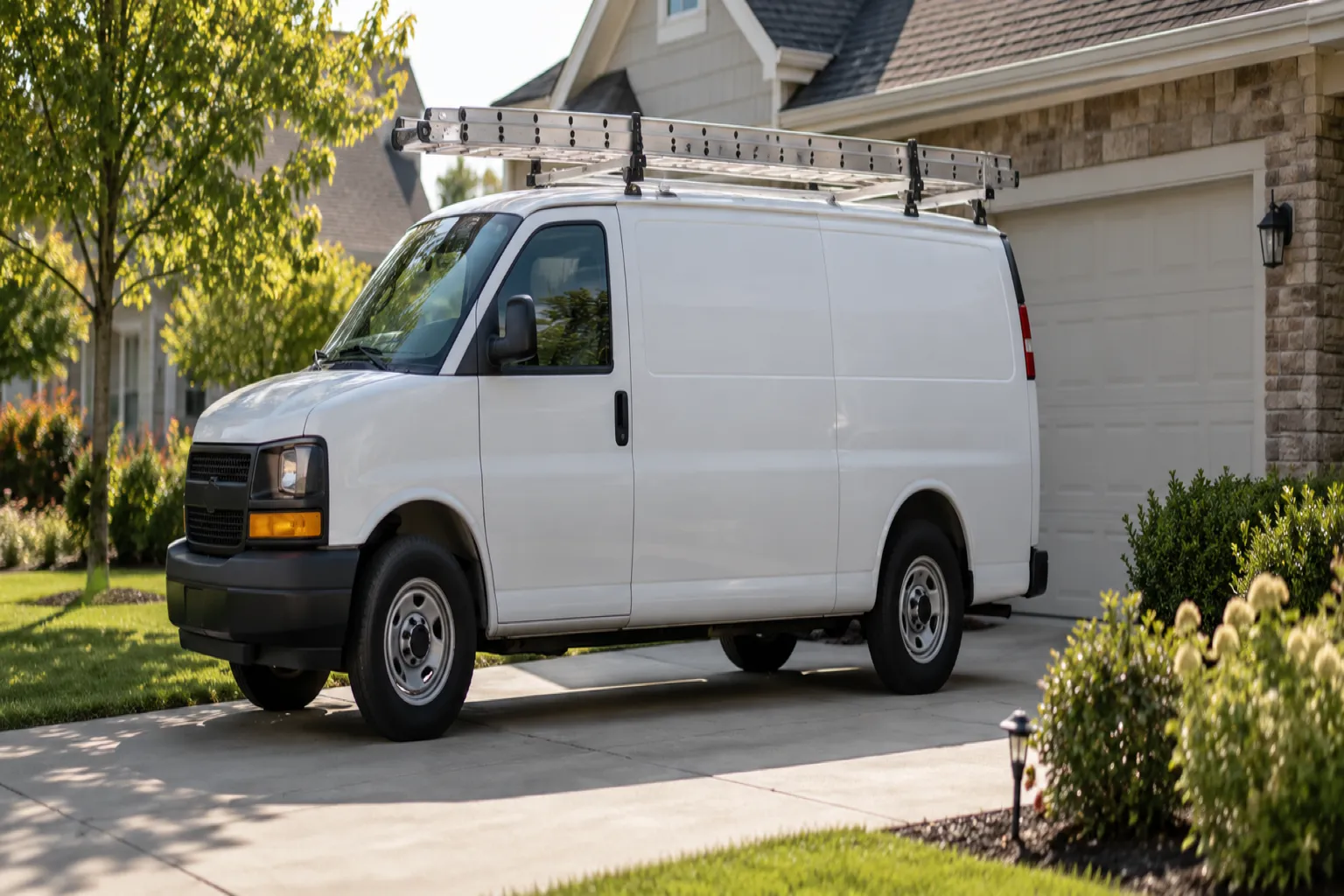
Yes, because they are the parts of your brand that people see in person. A clean, readable truck tells a homeowner that you take care of your equipment and plan to stay in business. You do not need a full wrap to get most of that benefit, only a name and number that can be read quickly.
Antonelli's article asks whether your truck attracts any attention for good reasons. It says contractors with unmarked, beat-up trucks and no uniforms or business cards do not instill confidence, and it warns that lettering and logos that are illegible from a distance are useless.
That last warning is easy to act on. Stand across the street from your truck and look at it. Can you read the company name and phone number in two seconds? If the name sits in a thin script font, or the number is small and low on the tailgate, a driver in the next lane cannot read it. Large, plain letters with strong contrast beat a clever design.
We could not find an independent study of how many people see a wrapped work vehicle each day. The figures that circulate come mostly from companies that sell wraps, so we leave them out. Judge the spending by your own numbers: ask new customers how they found you, and watch whether that answer changes after the truck is lettered. Ask the homeowner before you put up a job-site sign, check local rules, and take it down when the work is done.
How do reviews build your brand?
Reviews are where strangers decide whether to believe your promise. BrightLocal's 2026 survey of 1,002 US adults found that 97 percent of consumers read reviews for local businesses. Your rating, your review count and how recent the reviews are each shape the first impression.
The details come from BrightLocal's Local Consumer Review Survey 2026, a survey of US consumers, not of contractors, so treat the numbers as a guide to how people judge local businesses in general. In the survey:
- 41 percent said they always read reviews when looking for a business, up from 29 percent in 2025
- 68 percent said they require a business to have at least 4 stars, and only 10 percent require 5 stars
- 47 percent said they would not use a business with fewer than 20 reviews
- 74 percent said they look for reviews from the last three months
Three things follow for a small contractor. A good but not perfect rating is acceptable to most readers. A handful of reviews can lose a customer who wants to see volume. And reviews from the past few months count for more than a pile of old ones, so you need a steady trickle, not one push a year.
How you collect them matters as much as how many. The Federal Trade Commission's rule on consumer reviews and testimonials took effect on October 21, 2024. The FTC's questions and answers on the rule say a business may not write or buy fake reviews, and may not offer a reward tied to a particular sentiment, positive or negative. A business also may not use intimidation or an unfounded legal threat to stop a customer from posting a review or to get one removed. Asking every customer for an honest review is fine. Offering a discount for five stars is not. For the steps of asking, see our guide to getting more Google reviews.
Stop losing leads to slow follow-up
Most jobs go to the contractor who answers first. The Booking Flow captures every lead, lets them book a time on your Google Calendar right away, and sends follow-up emails to anyone who hasn't booked, so you close more without adding staff.
See plans & pricingHow should you reply to reviews, good and bad?
Reply to every review, in your own words, within a few days. A reply is public, it appears under the review as coming from your business, and future customers read it. Thank the customer when the review is good. Stay calm and factual when it is bad.
BrightLocal's 2026 survey found that 89 percent of consumers expect owners to respond to reviews, and that 80 percent are likely to use a business that responds to all of its reviews. And 42 percent are unlikely to use a business that never replies. On timing, 81 percent expect a response within a week, and 19 percent expect one the same day.
The same survey found that 50 percent of consumers are put off by templated or generic replies. A short reply that mentions the job does more. For example: "Thanks, Maria. Glad the new furnace is keeping the house warm, and we'll see you at next fall's tune-up." That example is made up to show the tone, not a real customer.
On Google, replies are public and reviewed. Google's help page says you must verify your business before you can reply, that each reply is checked against its content policies, and that the reviewer gets a notification and may change their review afterward.
For a bad review, thank them for telling you, state any factual mistake in a sentence or two, and offer to talk by phone or email. Do not argue the details in public. The upset customer may never change their mind, but future customers will read your answer. Our guide on responding to negative reviews goes through examples.
What should your website and photos say about you?
Your website should say who you are, where you work, what you do and how to ask for an estimate, in plain words and with the same name and look as your truck. Add real photos of finished work. Homeowners check you online even when a friend recommended you.
Houzz Pro's guide says to keep your visuals consistent and polished across website layout, project photos and typography, and that homeowners want to see project photos and read reviews before making an important hiring decision. It also says homeowners check online profiles even when they come through referrals. The guide gives a figure for how many do this but cites no source for it, so we do not repeat the number.
Photos of your crew at work, your trucks and your finished jobs say more than stock pictures. If you use a photo of a customer's home, ask first, and keep house numbers and any detail that identifies the family out of the shot. We cover page layout in our guide to website best practices for home service companies and what makes visitors trust a page in trust signals that convert contractor leads.
How does your first reply shape the brand?
The first message a homeowner gets from you is part of your brand. It shows whether you are organized and easy to deal with. A reply that comes from your company name and tells the person what happens next leaves a better impression than silence or a vague answer.
Owners with full schedules cannot always answer a form right away, and nobody should feel bad about that. We have no contractor-specific study that ties reply speed to booked jobs, so we will not claim one. We can say that a person who hears nothing may contact the next company on the list. A good first reply is short: it uses your company name, confirms you got the request and gives a clear next step, such as a link to pick a time.
What does a simple weekly brand routine look like?
Pick a few small tasks and do them every week. People recognize a company by seeing the same thing many times, so a routine you can keep beats a big project you drop. Block thirty minutes, reply to reviews, collect a photo or two and fix one mismatch.
- Reply to any new reviews, using the customer's name and one detail from the job.
- Ask for reviews from customers whose jobs finished this week, every customer and not only the ones you think were happy.
- Take two or three photos of finished work before you leave a job, and post one to your Google profile with a sentence about the work.
- Check one listing, such as a directory or social page, for the right name, phone number and service area.
- Look at the truck for dirt, damage or peeling lettering.
Over a year, a company that does these things will have more recent reviews, more photos and more matching listings than one that works in bursts. Our guide to social media for contractors covers posting in more detail.
How does your team become part of the brand?
Your crew is the part of the brand the customer meets in person. How they greet the homeowner, protect the floors, explain the work and clean up afterward is what the customer will describe to friends. Set the standard once, in plain words, and repeat it often.
Write a half page of expectations: how to introduce yourself at the door, how to explain a delay, and what to do before leaving, such as a walk-through and a quick cleanup. When a customer names a crew member in a review, read it out at the next team meeting. Referrals grow from this too, and our guide on a contractor referral program shows how to make them easy.
Where does The Booking Flow fit?
We handle one part of the brand: what happens after someone fills in your lead form. The lead gets an email right away, with a link to pick a time. Later emails remind them and ask for a review. None of that replaces a good truck or a good crew.
In more detail, every lead shows up in your dashboard, and you get an email alert for each one. The lead gets an email at any hour with a link to their own booking page. They pick a time, the visit goes on your Google Calendar, and they get a confirmation email with a calendar invite. A lead who has not booked gets three follow-up emails over seven days, by default on days one, three and seven. A lead who books at least a day ahead gets a reminder email the day before.
When you mark a job as Job done, the customer gets one email asking for a Google review, as long as you have added your Google review link in Settings. It goes to every customer marked Job done, never only the happy ones. We do not answer your phone, send text messages or take payments, and we work alongside whatever you already use for those jobs. To see the steps in order, read [how it works](/how-it-works/).